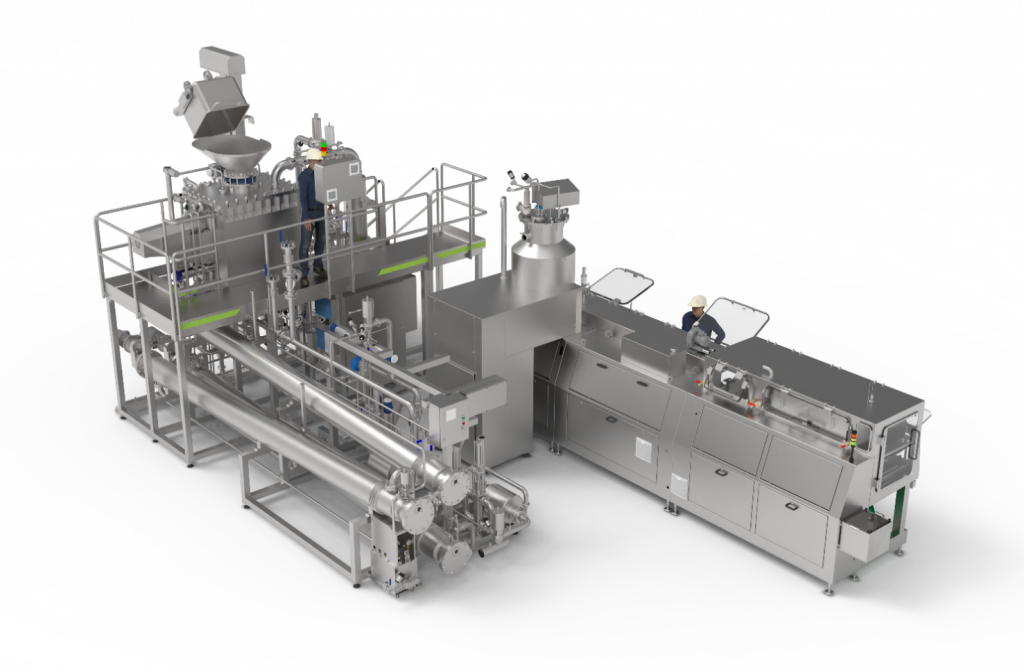
An integrated food production line combines cooking, sterilisation, thermal processing, aseptic transfer and filling within one coordinated system. Aurum Process Technology develops customised food processing lines around T-Sensation®, an aseptic technology that performs cooking and sterilisation in the same closed process, eliminating subsequent autoclaving. Under the conditions analysed by Aurum, this approach reduced calculated steam consumption by approximately 52%, while also reducing intermediate operations and enabling compact plant configurations with a footprint of approximately 32 to 65 m².
In food manufacturing, the real challenge is not simply finding individual machines capable of cooking, heat treating, homogenising or filling a product. It is ensuring that every stage works as part of a single, balanced and hygienic production process.
In a conventional configuration, cooking and sterilisation are generally performed in separate stages. The product is first cooked in a kettle, then discharged, cooled and packaged. The filled containers are subsequently transferred to an autoclave, where they are reheated and held at the required temperature for the time needed to achieve the target F₀ value. Finally, they must be cooled again before leaving the process.
Each additional stage requires time, energy, handling and production space.
Aurum Process Technology offers a different approach through T-Sensation®: an aseptic cooking system that integrates cooking and thermal treatment within a single closed process.
Instead of treating production as a collection of independent machines, Aurum designs customised, compact and scalable processing lines around the characteristics of each product and the operational requirements of each manufacturer.
The result is not simply a more connected line. It is a process designed to reduce unnecessary thermal loads, transfers and intermediate operations while protecting product quality and improving production efficiency.
T-Sensation®: cooking and sterilisation within one integrated process
The main difference between a conventional process and the Aurum approach lies in how cooking and sterilisation are carried out.
In a traditional kettle-and-autoclave configuration, the process involves several consecutive operations:
- The product is cooked in a kettle.
- It is discharged from the cooking system.
- The product is cooled and packaged.
- The filled containers are loaded into the autoclave.
- The product is reheated to the required sterilisation temperature.
- That temperature is maintained until the necessary F₀ value is achieved.
- The packaged product is cooled again.
- The containers are unloaded from the autoclave.
By contrast, T-Sensation® performs cooking and thermal treatment in the same closed, aseptic system, eliminating the need for subsequent autoclaving.
The system integrates mixing, heating, thermal treatment and sterile product transfer. Its agitation system with scrapers improves heat transfer and helps prevent product from adhering to the processing surfaces, making it particularly suitable for viscous and complex food formulations.
This approach reduces the number of operations required between raw material preparation and aseptic filling, creating a more direct and controlled production flow.
Approximately 52% lower steam consumption under the study conditions
A comparative energy study carried out by Aurum analysed the thermal requirements of two alternatives for processing the same quantity of food:
- A conventional system consisting of cooking in a kettle followed by autoclaving.
- A T-Sensation® system in which cooking and thermal treatment take place within a single piece of equipment.
Under the calculation assumptions used in the study, both systems were evaluated for a total product flow of 2,500 kg per hour.
The conventional kettle-and-autoclave process showed a total calculated thermal consumption of 556,500 kcal per cycle, while the T-Sensation® process required 270,000 kcal per cycle.
This represents a calculated reduction of 51.5% in steam consumption, or approximately 52% compared with conventional kettle cooking followed by autoclaving.
Under the conditions evaluated, T-Sensation® can therefore reduce steam consumption by approximately 52%.
This improvement is primarily associated with eliminating several thermal loads required by the conventional process:
- Reheating the product during the autoclaving stage.
- Heating the water contained in the autoclave.
- Heating the autoclave structure, trolleys and associated metal components.
- Compensating for the additional thermal losses generated by the second process stage.
With T-Sensation®, energy is applied directly and in a controlled manner to the product within a single system. There is no need to heat large volumes of autoclave water or repeatedly heat the mass of the autoclave and its loading equipment.
The precise result will always depend on the product, processing conditions, required capacity and final configuration. However, the study provides a quantified indication of the potential energy savings achieved by integrating cooking and sterilisation into one process.
Fewer intermediate stages and reduced process downtime
Energy consumption is not the only area in which the integrated Aurum process differs from conventional technology.
A traditional production line requires the product to move through several separate stages before and after autoclaving. Discharging, cooling, packaging, loading containers into the autoclave, reheating, holding, cooling and unloading all add time to the production cycle.
Although the exact reduction in process time depends on each application, T-Sensation® eliminates many of these intermediate operations by carrying out cooking and thermal treatment in one system.
This has a direct impact on production flow:
- Fewer product transfers.
- Less intermediate handling.
- No need to load and unload containers from an autoclave.
- No second reheating stage after packaging.
- Fewer interruptions between cooking and sterilisation.
- A more direct transition towards aseptic filling.
It would not be technically appropriate to attribute a universal percentage to this time reduction without analysing a specific installation. Nevertheless, removing complete stages from the process logically reduces non-productive operations and helps streamline the overall production cycle.
T-Sensation® does not simply accelerate an individual operation: it simplifies the entire process architecture.
A compact processing plant with a footprint of 32 to 65 m²
Production space is another important consideration when designing or expanding an industrial food plant.
A conventional configuration requires separate areas for the cooking system, product discharge, packaging, container handling and autoclaving. It may also require space for trolleys, loading operations and movement between the different stages.
By combining several operations within one integrated plant, T-Sensation® provides a more compact alternative.
Depending on the customer’s product, capacity and processing requirements, T-Sensation® plants have a footprint ranging from approximately 32 to 65 m².
This figure should not be interpreted as a fixed percentage reduction compared with conventional technology, as the surface area required by a kettle-and-autoclave system varies considerably between projects. However, it provides manufacturers with a clear reference for planning a new installation or evaluating the available space within an existing facility.
A compact plant can be particularly valuable when:
- Production space is limited.
- A manufacturer wants to increase capacity within an existing facility.
- Different process stages need to be brought closer together.
- The company wants to reduce internal product and personnel movements.
- A modular installation is required for future growth.
Faster and simpler cleaning within a compact process
Cleaning is another area that benefits from integrating several operations into a single plant.
In a conventional process, the kettle, transfer equipment, packaging area, autoclave and associated circuits may require separate cleaning procedures. The greater the number of systems and transfers involved, the more complex the cleaning strategy becomes.
Because T-Sensation® combines cooking and thermal treatment within a compact, closed plant, the cleaning process involves fewer separate processing stages and a more concentrated production circuit.
This can make cleaning cycles faster and simpler than cleaning two independent processes. However, as the exact reduction depends on the plant configuration, product and hygiene protocol, Aurum does not apply a standard percentage to this advantage.
Aurum can also integrate CIP stations into the complete production line. These systems automate the internal cleaning of tanks, piping and processing equipment, helping to:
- Standardise cleaning cycles.
- Reduce manual intervention.
- Improve repeatability.
- Simplify cleaning between batches.
- Optimise the use of water, detergent and energy according to the requirements of each installation.
The key advantage is not based on an unsupported universal saving. It lies in designing production and cleaning as parts of the same process from the beginning.
RM4.1: single-pass thermal processing for continuous production
Depending on the product and the required line configuration, Aurum can integrate the RM4.1 single-pass heat exchanger into the production process.
The RM4.1 is designed for single-pass operation, allowing the product to move through the thermal treatment stage without requiring the four-pass configuration associated with other systems.
This type of approach is particularly relevant when the objective is to create a continuous and coordinated production flow, reducing unnecessary recirculation or repeated movement through the process.
As with every Aurum technology, the RM4.1 is not selected as an isolated machine. Its suitability depends on factors including:
- Product viscosity.
- Particle size and composition.
- Heat sensitivity.
- Required thermal treatment.
- Production flow rate.
- Upstream and downstream equipment.
- Cleaning and hygiene requirements.
The value of the RM4.1 lies not only in its single-pass configuration, but also in its integration with the complete production process.
Integrated aseptic filling to protect the product until packaging
Once cooking and thermal treatment have been completed, the product must remain protected until it is packaged.
Aurum’s drum and Bag-in-Box filling system supports aseptic and hot-filling processes for liquid and semi-liquid food products, including purées, sauces, soups and plant-based preparations.
Integrating filling with T-Sensation® allows the thermally treated product to be transferred under controlled conditions to the packaging stage, avoiding unnecessary intermediate handling.
The filling system can accommodate different bag sizes and viscous products and is compatible with CIP and SIP processes.
The combination of aseptic cooking, thermal treatment and filling creates a continuous solution designed to maintain microbiological safety and product quality throughout the entire process.
One engineering partner for the complete line
Aurum’s approach goes beyond manufacturing individual equipment. Each project begins with an analysis of the product and its production requirements.
The engineering team assesses:
- Product viscosity and flow behaviour.
- Presence of fibres, seeds or particles.
- Heat sensitivity.
- Required F₀ value.
- Desired texture and homogeneity.
- Initial and future production capacity.
- Packaging format.
- Available production space.
- Cleaning requirements.
- Potential future expansion.
Based on these variables, Aurum configures a line that may combine T-Sensation® technology, single-pass thermal processing, homogenisation, aseptic filling and CIP cleaning.
This provides the customer with a single engineering partner capable of understanding and coordinating the complete process, rather than several suppliers focused exclusively on individual machines.
Measurable efficiency without unsupported promises
Every food processing project is different. For this reason, Aurum does not apply generic percentages to reductions in footprint, cleaning time, downtime or total process duration.
Instead, its engineering approach is based on analysing each application and identifying which operations can be simplified, integrated or eliminated.
The energy study does provide one clear and measurable result: under the evaluated conditions, T-Sensation® reduced calculated steam consumption by approximately 52% compared with conventional kettle cooking followed by autoclaving.
Other advantages derive directly from the process configuration:
- Cooking and sterilisation take place in the same system.
- The product does not require a second thermal treatment after packaging.
- Autoclave water and metal structures do not need to be heated.
- Several loading, unloading, cooling and transfer operations are eliminated.
- T-Sensation® plants occupy approximately 32 to 65 m², depending on project requirements.
- Cleaning is concentrated within a more compact and integrated process.
These benefits must always be assessed according to the specific product and installation. This makes the Aurum approach technically credible: performance is demonstrated through engineering analysis rather than generic claims.
From separate stages to a more efficient production strategy
The difference between standalone equipment and an integrated production line is not simply the number of machines involved. It lies in how many operations, transfers and thermal stages are required to achieve the final product.
With T-Sensation®, Aurum combines cooking and sterilisation within one closed, aseptic process. This eliminates the need for subsequent autoclaving and reduces the thermal loads associated with reheating the product, water and processing equipment.
The result is a calculated steam saving of approximately 52% under the conditions analysed, together with a more compact process and fewer intermediate operations.
Supported by technologies such as the RM4.1 single-pass heat exchanger, aseptic filling systems and integrated CIP stations, Aurum develops complete processing lines designed around each manufacturer’s product, facility and business objectives.
When several separate operations are transformed into one coordinated process, efficiency is no longer an abstract benefit. It becomes a measurable part of the production strategy.
Frequently Asked Questions
What is an integrated food production line?
An integrated food production line connects operations such as cooking, mixing, sterilisation, thermal processing, product transfer, filling and cleaning within one coordinated system. This reduces intermediate handling, unnecessary transfers and interruptions between production stages.
How does T-Sensation® differ from a conventional kettle-and-autoclave process?
A conventional process cooks the product in a kettle before packaging and sterilising it in an autoclave. T-Sensation® performs cooking and thermal treatment within the same closed, aseptic system, eliminating subsequent autoclaving and the need to reheat the packaged product.
How much steam can T-Sensation® save?
Under the conditions evaluated in Aurum’s comparative energy study, T-Sensation® reduced calculated steam consumption by approximately 51.5%, or around 52%, compared with conventional kettle cooking followed by autoclaving. Actual savings depend on the product, production capacity and process configuration.
How much space does a T-Sensation® processing plant require?
Depending on the product, required capacity and processing configuration, a T-Sensation® plant occupies approximately 32 to 65 m². Its compact design can help manufacturers increase capacity or install a complete processing line in facilities with limited space.
Which food products can be processed with an Aurum integrated line?
Aurum configures each line according to factors such as viscosity, particle size, heat sensitivity and packaging format. Its technologies can process liquid, semi-liquid and viscous foods, including sauces, soups, purées and plant-based preparations.